When a camera beats a guess
Plenty of sewer problems look alike from the outside. A slow main drain, a gurgle after you flush, a sewer smell in one bathroom and a wet patch in the yard (which might also be a water supply leak, so ask about leak detection) can all trace back to different faults. Cleaning the line may clear the symptom for a week and leave the cause.
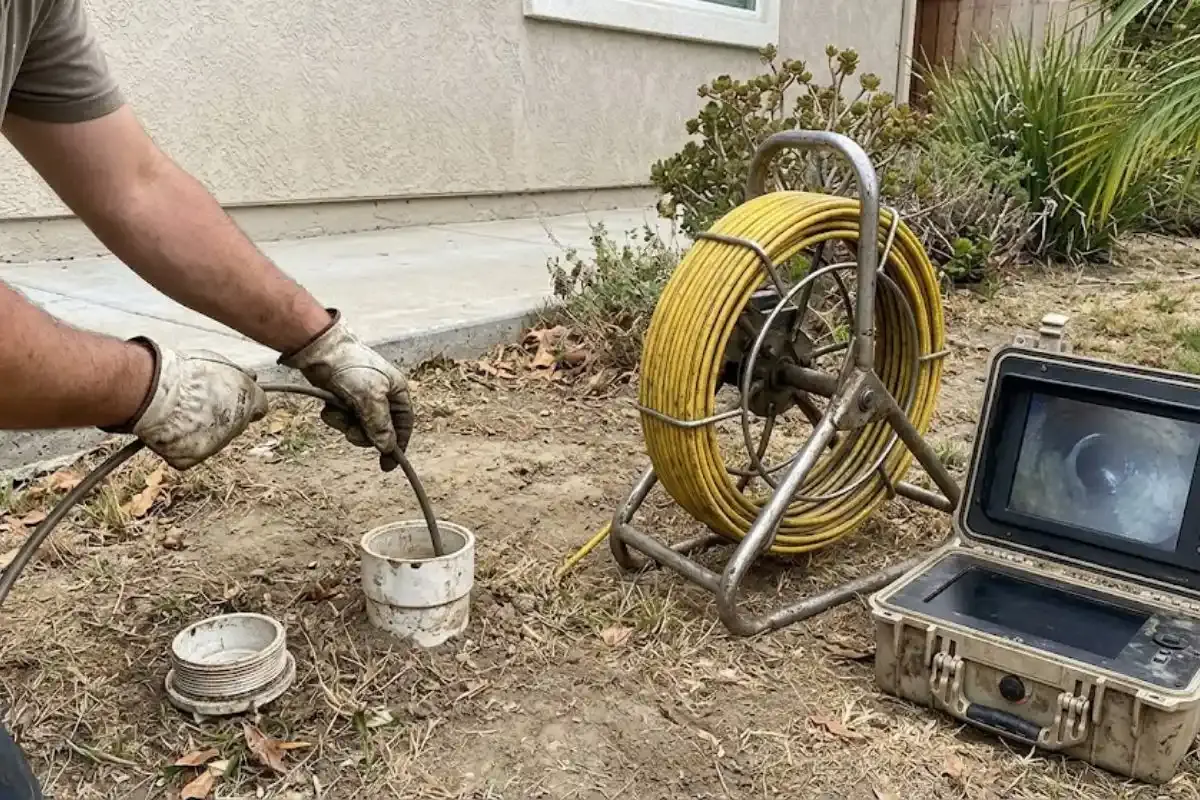
A camera run answers the question before money goes into digging or relining. It shows whether the pipe is cracked, offset, root-filled, bellied or just greasy. We treat it as a way to decide, and sometimes it tells you the line is fine.
Good reasons to book a camera run
- Repeated clogs in the main drain after cleaning
- A sewer smell that comes and goes with no dry trap to blame
- Soggy or sunken ground along the line from the house to the street
- Buying a house and wanting to know what is under the lawn
- A past repair you want checked
What happens during the inspection
Find the way in
We look for a cleanout near the foundation or a pulled toilet as the entry point. No cleanout means a bigger job, and we tell you that first.
Feed the camera
The camera travels down the line while a screen shows live video and a footage counter. We stop at anything that looks wrong.
Locate the problem
A transmitter in the camera head lets us trace the spot above ground, so you know how deep and where it sits.
Review it together
You see the images, hear what we found and get options with a clear price before work starts.
Why age matters under North Chicago lawns
About 32 percent of North Chicago's housing was built before 1960, and nearly 19 percent before 1940. Older service lines can be clay tile, cast iron or early plastic that has shifted, and tree roots find joints in these materials easily. We do not assume anything until we have seen it on camera.
Newer homes are not exempt. The median year built here is 1973, which still puts many lines past the half-century mark. Builders' backfill settles and pipes sag, so low spots collect waste and then clog.
| Era built | Common finding | Usual next step |
|---|---|---|
| Before 1940 | Offset joints, root intrusion, collapsed sections | Spot repair, lining or replacement of the bad length |
| 1940 to 1959 | Root growth at joints, scale in iron pipe | Cleaning plus a re-inspection |
| 1960s and 1970s | Bellies and low spots from settling | Spot excavation or a locate and repair |
| 1980s and newer | Grease and debris more than damage | Cleaning and a maintenance plan |
Which sewer: ours, the street, or the district
Who is responsible for what
North Chicago's sewage is handled by the North Shore Water Reclamation District, which says the sanitary and storm sewers in its service area are separate systems with no combined sewers. A camera run helps you find out which side of that line a problem sits on.
The city has its own sanitary sewer cleaning and televising program for its mains. Your private lateral, the pipe from the house to the connection, is generally the property owner's concern, but who owns the local collector sewers is not clear in the city's public material. Ask the city before you pay for work out in the street.
After the footage: your options
If the camera finds roots, a sewer line cleaning visit may restore flow, and we can re-inspect to check the pipe wall. If it finds a break or collapse, the fix is a sewer line repair, which may be a short spot dig or a longer replacement.
Before any digging, we call JULIE at 811 so underground utilities are marked. Private sewer work can also need approval from the city, so we ask about that before we start rather than after.
What an inspection costs, and what changes it
What changes the price
A camera visit is priced by how hard the line is to reach and how much we need to find.
Describe the symptom and get a clear price before work starts.
Call (847) 281-8626Before the camera visit
Before We Arrive
Find your cleanout
It is usually a capped pipe near the foundation or in the basement. Tell us if you cannot find it.
Note when it happens
Does it back up after laundry, after rain or only upstairs? The pattern tells us where to look.
Hold off on chemicals
Liquid drain openers sit in the line and are unpleasant to work around.
Gather paperwork
A home inspection report or past repair bill helps us compare what we see to what was found before.
Sewer camera questions
Yes. We are open 24/7, and an active sewage backup is urgent. Planned camera inspections get a same-day appointment when available.
Often, by pulling a toilet or going in through a roof vent, but it takes more time. We tell you the plan before we start.
We can save footage and tell you what we found. If a buyer, seller or insurer needs a specific format, say so before the visit.
No. The cable is flexible and built for pipe work. If the line is already fragile, we say so before we push through.
Not by itself. It finds the cause. Cleaning, jetting or repair comes after, and we explain the options with a clear price before work starts.
Yes. If you are in Lake Bluff or elsewhere nearby, call and we will plan the visit.
Book a look inside your line
Call and describe what you are seeing. We will plan the camera run and tell you what to expect.
Call (847) 281-8626