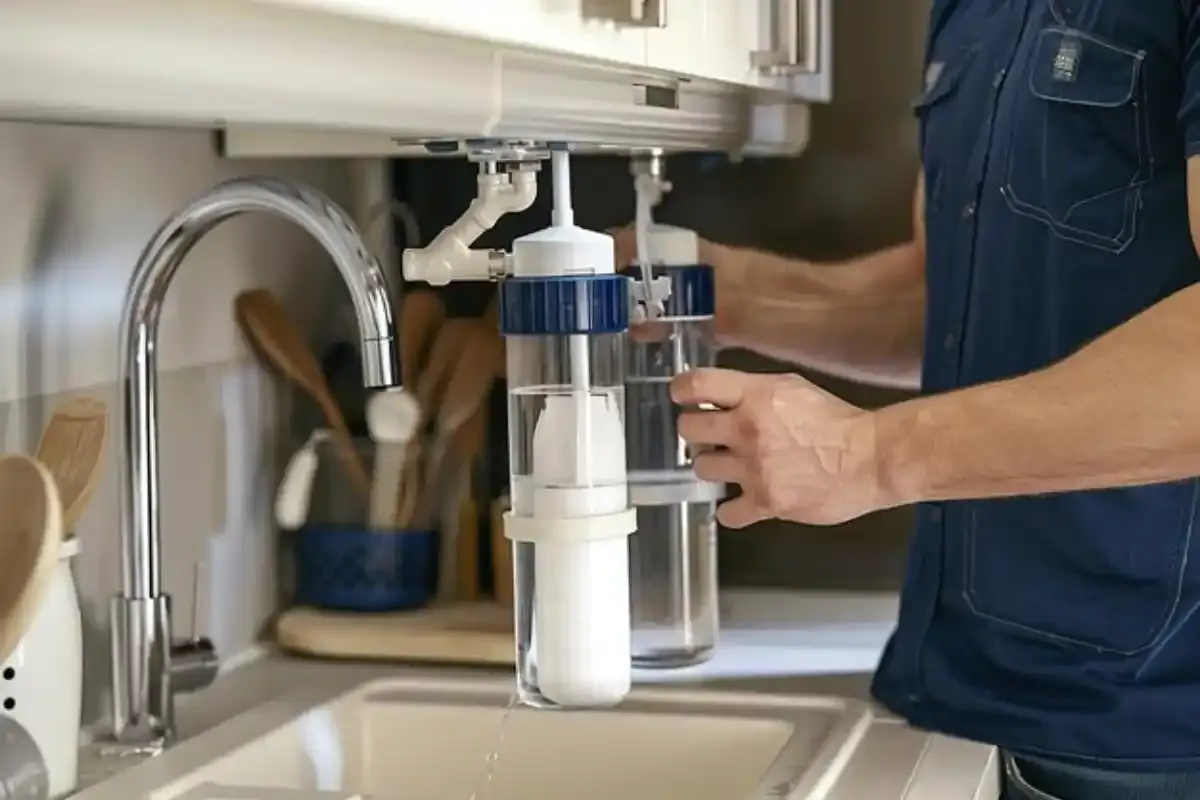
Three kinds of under-sink filter, side by side
The names on the box matter less than the certification printed on it.
Carbon block filter
Cleans up chlorine taste and smell and traps some particles. Simple, low cost to run, and the usual first choice for city water that tastes of chlorine. Cartridges are changed on a schedule.
Carbon plus lead-rated cartridge
Adds a media rated for lead and certain other metals. Worth a look if your home has an older service line or older solder joints. The label must say lead reduction, not just filtration.
Reverse osmosis
Pushes water through a fine membrane into a small storage tank and gives it its own faucet. Cuts more dissolved material, but needs more space, a drain connection and membrane changes.
None of these makes water sterile, and none replaces the city's treatment. They are point-of-use tools. The goal is cleaner water at the tap you use for drinking, coffee and cooking, which is a tiny fraction of the water your home uses.
Read the label before you buy
Look for NSF/ANSI certification marks on the box and the cartridge. Standard 42 covers taste and odor such as chlorine. Standard 53 covers health-related reductions such as lead. A claim that is not backed by one of these marks is just marketing.
Check the replacement cartridge cost and how often you must swap it. A cheap housing with an expensive cartridge costs more over a few years than a pricier unit with a common cartridge. Also check the flow rate, since a filter that fills a glass slowly gets switched off and ignored.
| Feature | Why it matters | What to look for |
|---|---|---|
| Certification | Proves the filter does what it claims | NSF/ANSI 42 for taste, 53 for lead and health claims |
| Cartridge life | Spent media stops working, and may release what it caught | A clear gallon or month limit, and a way to track the date |
| Flow rate | Slow filters get bypassed | Enough flow to fill a pot without waiting |
| Space under the sink | Garbage disposals and pipes take room | Measure the cabinet, including the drain trap |
| Faucet | Most units need a small extra faucet or a connection to the existing one | A hole in the sink or countertop, or a supply tee |
What North Chicago's water report actually says
North Chicago draws its water from Lake Michigan through two intakes and treats it at the city plant on Lakeview Drive. The most recent report posted on the city site covers 2023. It lists chlorine as the disinfectant, with a highest running average of 1.4 ppm against a limit of 4 ppm and no violation. That chlorine is the taste most people notice, and a carbon block handles it well.
The same report shows fluoride at 0.6 ppm and sodium at 15 ppm. It does not print a hardness number. We will not guess one for you. If scale on your kettle and fixtures bothers you, buy a cheap hardness test strip kit and test your own tap, because a filter is the wrong tool for hardness while a softener is the right one.
PFAS testing is posted on a separate city page. If that is your concern, read the lab sheet, then look for a filter whose certification names PFAS reduction. Do not assume a basic carbon cartridge covers it.
Lead: the reason many North Chicago homes should ask about the line
The city's lead service line plan lists 5,653 service lines. Of those, 849 are lead and 144 are galvanized lines that need replacement. A lead filter is a sensible stopgap while that is sorted out, but it is not a substitute for knowing what runs from the street to your meter.
Look where the pipe enters your basement, just before the meter. Lead is dull gray and soft enough to scratch with a key, and a magnet will not stick to it. Do not scrape hard. If you are not sure, a plumber can identify it in minutes. Replacing a failing or lead service pipe is the job of water service line repair, and it is a different project from picking a faucet filter.
About two thirds of households in the city rent. If you rent, ask your landlord what material your service line is and tell them in writing if you want a lead-rated filter. If you own, the city is replacing lead lines at no cost in one defined area, so check whether yours is included before paying for private work.
How we install one, start to finish
Check the cabinet and shutoffs
We look at the supply valves, the drain, and whether a disposal leaves room under the sink.
Shut off and tap in
Water to the sink is closed, the cold supply gets a tee or a dedicated line, and the housing is mounted to the cabinet wall.
Add the faucet
A dedicated filtered faucet goes in a spare sink hole or a drilled countertop hole, with tubing run to the unit.
Flush and test
We flush new cartridges as the maker directs, check every fitting for drips, and run water at full flow.
Set the change date
We write the cartridge change date on the housing so you are not guessing in six months.
Want a filter sized to your sink and your questions about the water? We can talk it through and install it.
Call (847) 281-8626Two neighboring towns, two different answers
Do not copy a neighbor's filter choice without checking whose water they drink. Waukegan runs its own plant, and the city says lead is not present in its treated water, though the city still runs a lead service line replacement program. Hardness is not printed in what we could read.
In Lake Bluff, the village buys its water from the Central Lake County Joint Action Water Agency, and the agency adds phosphate to keep lead and copper out of home plumbing. The agency's own FAQ gives hardness as about 8 grains per gallon, which is moderately hard. Same lake, different supply, different tap results.
What a sink filter will not do
It will not soften your whole house, protect your water heater from scale, or fix a rusty service line. It will not remove everything the label does not name. And it will make water worse if the cartridge goes unchanged for a year. If your real problem is scale or a corroding line, tell us, and we will point you to the right fix instead of selling a filter.
What we can verify about North Chicago water
North Chicago water, from the city's own records
The city's published water quality report for 2023 lists Lake Michigan as the source, with chlorine as the disinfectant. It reports a lead 90th percentile of 15 ppb, which sits at the federal action level, with three sampling sites over it. Copper came in at 0.046 ppm with no sites over the limit.
The city's lead service line replacement plan, dated September 2024, counts 849 lead lines and 144 galvanized lines needing replacement out of 5,653.
The city page says it is replacing lead lines at no cost to owners in eligible properties east of Green Bay Road, south of Argonne Road and north of Broadway Avenue, with Illinois EPA grant funding. A large part of the city is Navy property served by the Navy's own water system, so these figures do not describe base housing.
Filter questions answered
The city's 2023 report lists no violation, but its lead sampling result sat right at the federal action level. Many people filter for taste, and some filter for lead as a precaution.
If you have a young child or are pregnant, ask your doctor and your landlord or utility about service line material and testing.
The city's reports list chlorine as the disinfectant and do not mention chloramine. Hardness is not published in the reports we read, so we cannot give you a number.
Test your tap with a hardness kit, or ask the city water department. That tells you more than a neighbor's guess.
It depends on the model and your water use, and the manufacturer sets the limit. Many carbon cartridges are changed every few months, and reverse osmosis membranes last longer than the prefilters.
Follow the maker's schedule. A spent cartridge can pass what it once caught.
No. A sink filter treats one faucet and a softener treats the water for the whole house. They solve different problems, and some homes use both.
If scale is your issue, start with the water softener and filtration page and a hardness test.
If the line is lead, replacement is the lasting fix, and the city is funding some of it. A filter is a reasonable bridge in the meantime.
We can identify the pipe and give you a price before any work starts.
Start with the tap you drink from
Call us to talk through a filter for your sink or to look at the line coming into the house. We are open 24/7.
Call (847) 281-8626