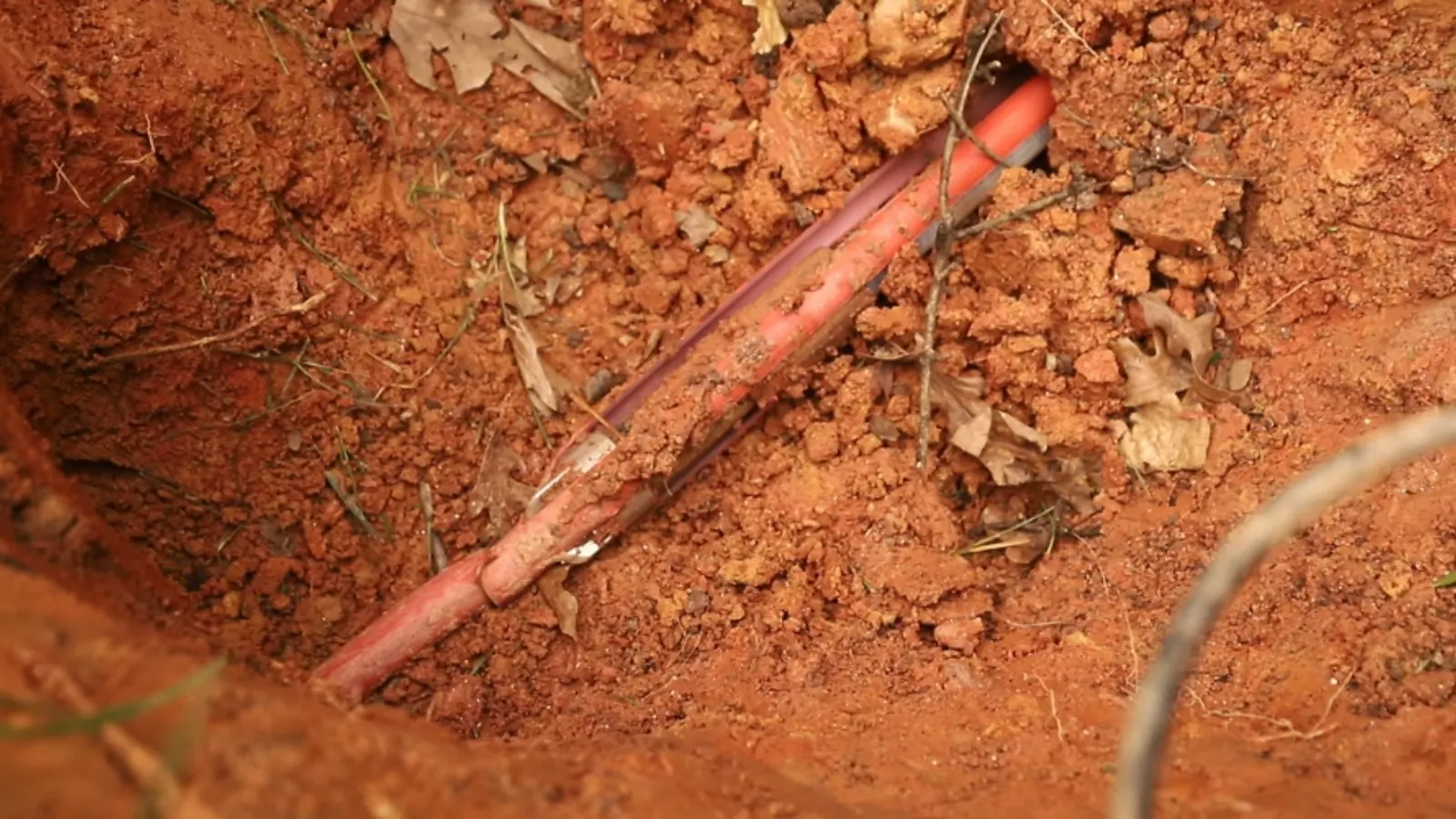
Line broken or leaking: what to do in the first hour
Close the main valve
Find the valve where the water line enters the building, normally beside the meter. Turn it clockwise. If it is stuck or leaking, do not force it.
Check the meter
With every fixture off, look at the dial or small triangle on the meter. If it still moves, water is escaping somewhere between the meter and the fixtures, or before it.
Look at the ground
Soft soil, a sunken patch or water bubbling near the foundation points to a buried leak. Photograph it.
Call the right people
Call us for the pipe on your property. If you think the break is in the street or at the connection to the main, the city water department's after-hours line is 847-596-8774.
Do not start digging yourself. Call JULIE at 811 before any digging, because a service line may sit close to gas, electric or communications lines.
Signs the buried line is failing before it breaks
- Pressure drops at every fixture. Low pressure through the whole house points to the line, a partly closed main valve, or corrosion narrowing the pipe. One faucet alone is usually a local clog.
- A water bill climbs with no change in use. A slow buried leak can run for weeks before anything shows on the surface.
- Wet or unusually green spots in the yard. Soil that stays soft in dry weather is worth a look.
- Discolored water after the line is disturbed. Rust-colored or cloudy water points to old steel or galvanized pipe shedding scale.
- Meter moves with everything off. The simplest test for any leak, and one we use on every service line call.
If you cannot tell whether the leak is on the service line or inside the house, a trace helps. Our leak detection team can locate a buried leak without digging a trench to find it, and tell you whether it is on this line.
North Chicago's lead line count, in the city's own numbers
What the city's 2024 plan says
The lead service line plan the city filed on September 1, 2024 counts 5,653 service lines in all. Of those, 849 are lead, 144 are galvanized and need replacement, and 4,660 are not lead. The plan's table shows no lines in an unknown, suspected-lead category.
The city's 2023 water quality report shows a lead 90th percentile of 15 parts per billion, the same number as the federal action level, with 3 sample sites over it and no violation recorded. A lead line does not mean the water at your tap is unsafe on its own, but it is a reason to ask the city about testing and to use a filter certified for lead until the line is checked.
We cannot tell you your line's material from the street. We can look at the pipe where it enters your basement or utility space and tell you what it appears to be. A magnet, a scratch test and the color help, and you can confirm against the city's inventory.
The city's free replacement phase, and who is in it
Next door in Waukegan the city runs its own separate lead program. Here, North Chicago is replacing lead service lines at no cost to property owners in one defined area, bounded by Green Bay Road on the west, Argonne Road to the north and Broadway Avenue to the south. This phase covers about 175 properties and is paid for by an Illinois EPA grant. Owners in the area must sign an access form before crews can work.
If your address is inside that boundary, call the city water department before you hire anyone. The city runs that program, we do not, and you should not pay for work the program covers. If your home is outside it, a replacement is a private job. We can quote it, show you what the work will involve, and name the price before any digging.
Naval property takes up a big share of the city and runs on the Navy's own water system, so the city's inventory does not cover those homes. If you live in Navy housing, ask your housing office, not the city.
Repair a section, replace the line, or reroute
| Condition | Usual option | Notes |
|---|---|---|
| One clean break in a copper line | Spot repair | Works when the rest of the pipe is sound |
| Repeated leaks on old steel or galvanized | Replace the line | A patch will fail again at the next weak spot |
| Lead line confirmed | Replace the line | Check city program eligibility first |
| Line passes under a slab or driveway | Trenchless or reroute | Depends on what the dig can reach |
| Low pressure with no leak | Inspect and possibly replace | Corrosion inside can narrow the pipe |
For a house with several failing pipe runs inside, repiping may belong in the same conversation, and for a pipe that has already burst, our burst pipe repair page covers the interior side.
How a service line job runs
Locate the line and call JULIE
Utility marking comes before any excavation. We tell you what dig timing that adds.
Ask about permits
The city building department, 847-596-8650, tells us what applies to your address. We do not assume.
Expose, repair or replace
We open only what we need and keep your yard, driveway or sidewalk in view before we touch them.
Test and restore
We pressure test the new pipe, flush the line, and tell you what to restore on the surface.
Plumbers in Illinois are licensed by the state's public health department. We are licensed and insured, and proof is yours for the asking.
What a service line repair costs
What changes the price
Patching one spot and replacing the whole line are far apart in scope. We give you the number before the trench opens.
Line leaking now? Call and we will get a crew headed your way.
Call (847) 281-8626Service line questions we get
Day or night, the phones are staffed. Close your main valve, describe the meter and the yard to the dispatcher, and we will book the first opening, often the same day.
If the break appears to be in the street, the city water department also keeps an after-hours line, 847-596-8774.
Check where the pipe enters the building. Lead is a dull gray metal that a key scratches easily and a magnet ignores. Copper is orange-brown, galvanized steel is magnetic. The city also publishes an inventory, so compare what you see with it.
No. The city's current phase covers eligible properties inside its Green Bay, Argonne and Broadway boundary, about 175 in all. Call the city water department to confirm your address.
We do not assume. Ask the city water department where its responsibility ends and yours begins before authorizing work, because the answer changes who pays.
Common causes are a partly closed main valve, a failing pressure regulator, or corrosion inside an old service line. We check the valve and the regulator first, because those are the quickest to rule out.
The owner or manager should authorize any dig. Tenants can still call us to stop an active leak, and we will tell you what we found so you can pass it on.
Water line down or leaking?
Close the main valve and call. A dispatcher will line up the first crew available.
Call (847) 281-8626