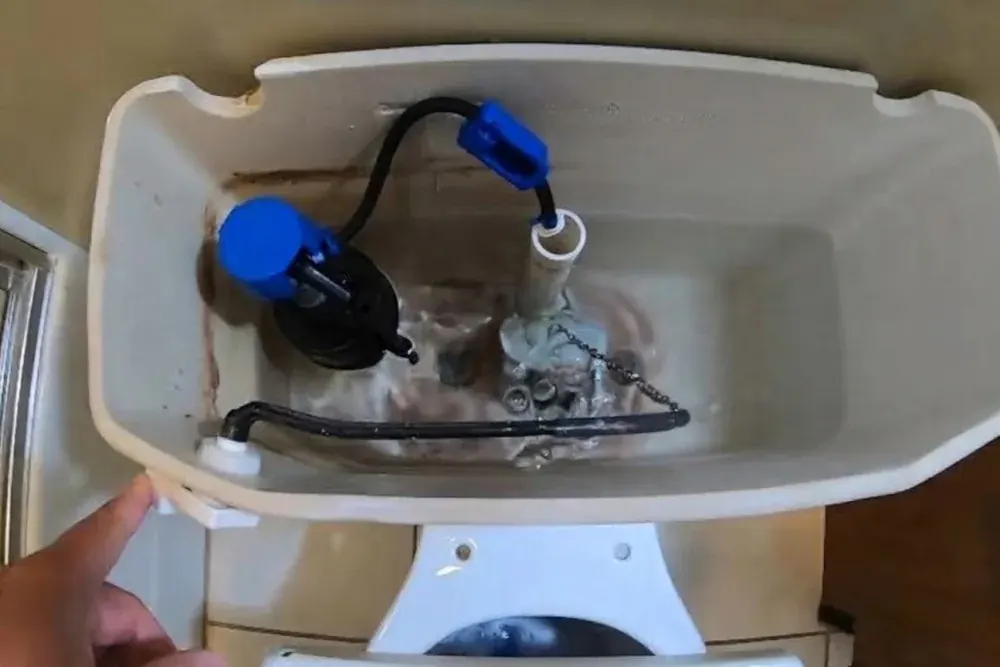
Stop the water first, then call
Close the wall valve
The oval handle near the floor behind the toilet. Turn it clockwise until it stops. If it will not turn, do not force it, tell us when you call.
Lift the tank lid and hold the float up
If water is still pouring into the bowl, raising the float arm stops the fill.
Do not flush again
A second flush into a blocked trap pushes water onto the floor.
Mop and open a window
Water on a bathroom floor can run into the ceiling below, which matters in any upstairs unit.
Once the water is off, you are safe to wait for us. A visit the same day is often possible, and the dispatcher will ask if you have a second bathroom, so you know how long the household can wait.
Match the symptom to the likely fix
| What you notice | Usual cause | Typical fix |
|---|---|---|
| Hissing or running for minutes after a flush | Worn flapper or fill valve | Replace the parts inside the tank |
| Puddle around the base | Failed wax ring or loose bolts | Pull the toilet and reseal it |
| Water on the floor behind the bowl | Supply line or tank bolt leak | New supply line or tank gasket |
| Weak or slow flush | Clogged rim jets or low tank water level | Clear the jets and reset the fill |
| Gurgling when the tub drains | Partial blockage in the drain line | Cable the drain, see below |
| Rocking bowl | Loose flange or bolts | Re-anchor the toilet |
Running toilets waste more water than most people expect and often drive up the next bill. If your water charge climbed and the toilet is quiet, the leak may be elsewhere, and our leak detection team can trace it.
One toilet or the whole building?
About 28 percent of the housing units in North Chicago are in buildings of five or more units, and another 1,600 or so are in two to four unit buildings. In those buildings a toilet that backs up may be the first fixture to show a shared stack problem, not a bad toilet.
Quick test: flush the toilet and run the tub at the same time. If both slow down together, or a neighbor reports the same, the blockage is on the shared line. We will clear what we can reach and suggest sewer line cleaning when the cause sits beyond the toilet's own trap. If only this toilet fails, the cause is in the toilet or its drain, and we fix it on the spot.
Tenants, landlords and who authorizes the work
Roughly two of every three occupied homes in the city are rentals, so plenty of toilet calls start with a tenant trying to reach an owner who is asleep. We will stabilize the situation, stop the water, and tell you what we found in plain terms you can forward.
What property managers can ask us for
- A short written note on the cause and the part replaced.
- A call to the owner or manager before work that goes beyond the first fix.
- A list of units on the same stack if the problem looks shared.
- A clear price before work starts, so nobody finds out afterward.
If a landlord has not responded, keep your own record of the time you called and what the toilet was doing. Our crews also work in nearby Waukegan, where we also see renters and owners with the same calls. We cannot decide who pays under your lease, but we can describe the repair accurately.
Older bathrooms, older parts
What the housing stock means for toilets
Half of North Chicago's homes went up in 1973 or earlier, and about 32 percent predate 1960. In houses that old, the original shutoff valves have often not turned in decades, and a stiff or weeping valve is the reason many simple toilet repairs stretch into valve replacement.
Floors under older toilets also soften when a wax seal has leaked slowly for years. We press around the base before we reset anything. If the subfloor is soft, we tell you before we reinstall, because a rocking toilet on a rotten floor will fail again.
Repair, or put in a new toilet?
Most running or leaking toilets are repair jobs. A cracked bowl or tank, a glaze gone rough from years of cleaners, or repeated clogs from a poor design usually point toward replacement. Our plumbing installation crew can set a new toilet the same visit if you have one ready, or help you choose a size that fits your rough-in.
Pressure-assist and standard gravity toilets use different parts, and we say which you have before ordering anything. If a bowl clogs weekly and the drain is the real cause, a new toilet will not help, and our drain cleaning page explains what we do for that.
What a toilet repair costs
What changes the price
Swapping a flapper takes minutes, while pulling the toilet for a new seal takes longer. We name the price before touching anything.
Toilet still misbehaving? Call and ask for the next open slot.
Call (847) 281-8626Quick answers about toilet trouble
Overflows, cracked tanks and leaking bases are all fair game at any hour, and the line is staffed 24/7. Close the wall valve first, and we will book the fastest visit the day allows.
That is usually a flapper that no longer seals, so water trickles from the tank into the bowl and the fill valve tops it off. It is one of the cheapest fixes we do, and it is worth fixing before it drives up your water bill.
Once, gently, with the wall valve closed. If water keeps coming up, stop. Repeated plunging against a deeper blockage can push waste out of the base.
Rarely. It usually means the drain line is partly blocked and air is being pushed through the trap. We can clear it, and we will tell you if the stoppage looks like it is on the shared stack.
Yes. Tell us the model and the rough-in measurement, meaning how far the drain outlet sits from the finished wall. We will confirm it fits before we start.
Shut the wall valve to limit damage and keep a record of when you called. You can also call us for an emergency stop. We will describe the repair in writing so you can pass it to the owner.
Toilet flooding or leaking now?
Water off at the wall valve? Good. Now call, and a dispatcher will line up the quickest visit.
Call (847) 281-8626