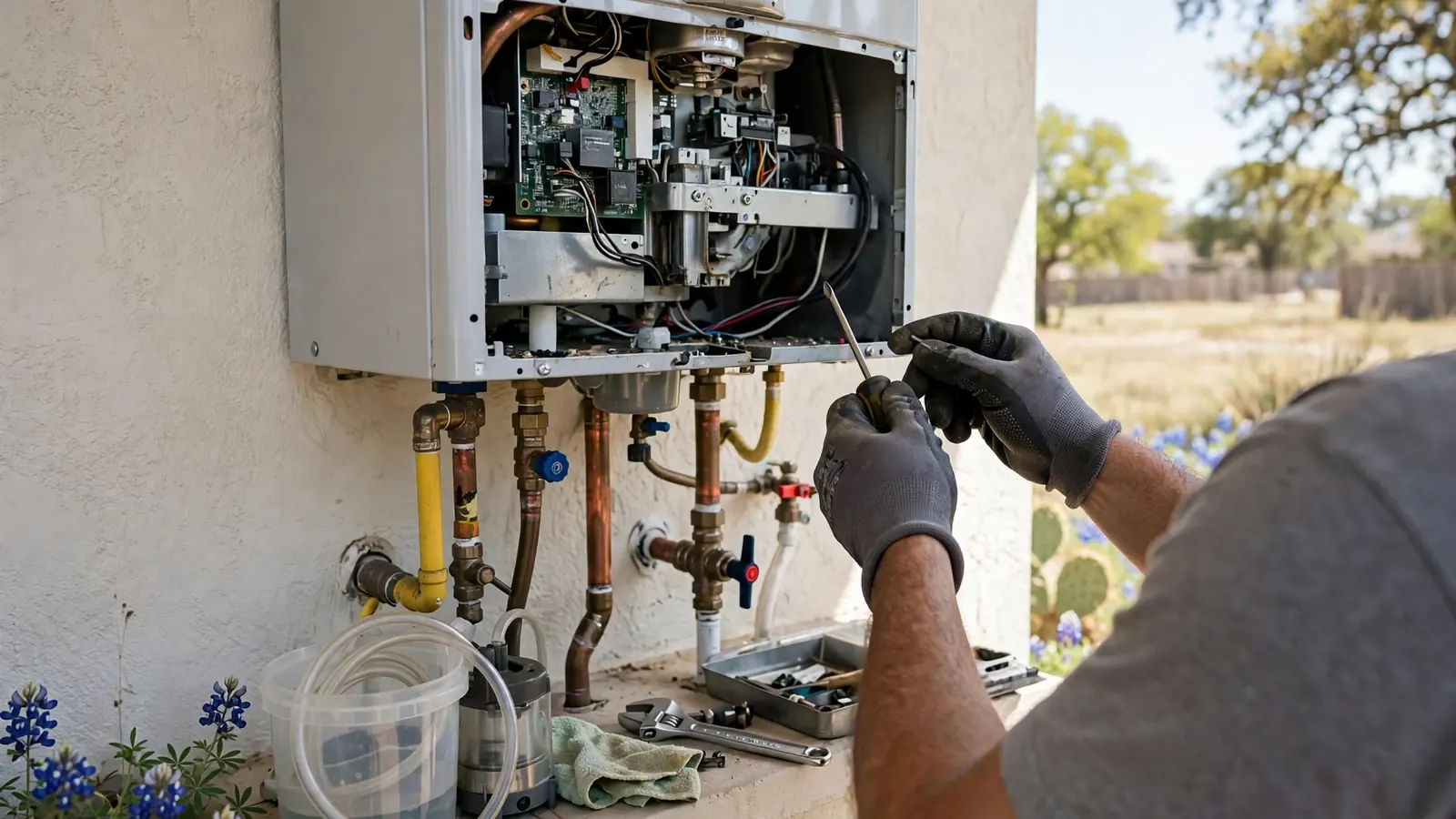
Gas or electric: how the two types compare
A tankless unit has no storage tank. When you open a hot tap, flow sensors start a heat source that warms water as it passes through. That source is either a gas burner or electric elements. Both give hot water on demand. They differ in what they ask from the building.
| Item | Gas tankless | Electric tankless |
|---|---|---|
| Fuel supply | Natural gas or propane through a gas line sized for the unit | Electric power through dedicated high-amp breakers |
| Venting | Required, and the type depends on the model | None, no combustion |
| Condensate drain | Needed on condensing models | Not needed |
| Common house issue | Gas line too small, or vent route hard to build | Panel too full or service too small |
| Who does the work | Licensed plumber for gas piping and connections | Licensed plumber for water side, electrician for circuits |
| Power during an outage | Most still need a little electricity for controls | Does not run without power |
Notice the last row. A gas tankless unit does not work in a power outage unless it has a backup, because the fan and controls are electric. A standard gas tank with a pilot can keep making hot water when the lights go out. That detail catches people off guard.
Why gas capacity decides the whole job
A gas tank heater sips fuel while it keeps a tank warm. A gas tankless heater has to heat a continuous stream of cold water to shower temperature in seconds, so its burner draws far more gas at the moment it fires, often several times what a tank pulls. Your meter, your main gas line, and the branch to the heater all have to carry that load while the furnace and range are running too.
If the existing pipe is undersized, the fix is a larger line, which is real piping work behind walls or across a basement ceiling. That is why we look at the gas run before we talk about equipment. Our tankless water heater page lists what we examine on a site visit.
Safety first: gas piping is not a DIY job
We do not give step-by-step instructions for connecting or modifying gas lines, and you should not attempt it. A bad fitting can leak without any visible sign. Use a licensed plumber, and expect the work to be pressure tested before the unit is lit.
If you ever smell gas, do not flip switches or look for the source. Get everyone out, then call your gas utility or 911 from outside.
Venting: where the exhaust goes
Every gas heater must send its exhaust outdoors. Older tank heaters often share a masonry chimney. Tankless models usually cannot, because their exhaust is cooler and wetter, and the old flue can collect moisture and corrode. High-efficiency condensing units use plastic vent pipe that runs out through a wall or roof, and they drain acidic condensate that must go to a proper drain.
The route matters. A vent that must run twenty feet with several turns is a different job than one that exits a wall three feet away. Clearances from windows, meters, and property lines are set by the manufacturer and the local code, so the installer needs to see the room before pricing anything.
Questions to settle before you order
Pick the fuel that your house already supports
If gas service is in the building, gas is likely the easier path. If not, an electric unit may need a service upgrade, which is a larger project than the heater.
Find the gas line size and the meter capacity
Ask the installer to confirm both. This is the step that people skip and regret.
Walk the vent route with the installer
Agree on where the exhaust leaves the building and where the condensate will drain.
Decide on water treatment
Mineral scale shortens the life of a heat exchanger. Ask about isolation valves that make flushing easy, and about a scale filter if your water leaves deposits.
Confirm the permit path
Ask the building department what your town requires for a water heater, and who pulls the permit.
For a straight swap of a gas tank to a gas tankless unit, our water heater installation crew handles the plumbing, the gas connection, and the testing as one visit when the gas line and vent are already suitable.
Gurnee and Lake Forest: what the local pages say
Gurnee and Lake Forest rules and water facts that touch a tankless install
The Village of Gurnee handles water heaters through its Building Safety Division. The village's water heater page asks for the name of a licensed plumber, who must be registered with the village before the permit is released, plus a written letter of intent from that plumber, on company letterhead and signed, notarized or carrying a corporate seal. A tankless installation in Gurnee follows that path, so the schedule should leave time for it.
On water quality, the village describes Gurnee's water as moderately hard, at approximately 8 grains per gallon or 137 milligrams per liter as calcium carbonate. Harder water leaves scale on hot surfaces, which is exactly what a tankless heat exchanger is. That is the practical reason we talk about flush valves and routine descaling with Gurnee customers.
The City of Lake Forest lists a residential Water Heater Permit on its building permits page and adopts the Illinois Plumbing Code with local changes, along with the International Fuel Gas Code. The page does not describe when the permit is required, so confirm with the Community Development department. Lake Forest does not publish a hardness figure that we could find, so we say nothing about it and suggest testing your tap.
If you live in the village, our Gurnee plumbing page explains how we work there. For the city, see Lake Forest plumbing service, a short drive south from our Skokie Highway address.
Where the price of a gas tankless install comes from
What changes the price
Tankless pricing swings more than tank pricing because the work around the unit varies so much.
Want a clear price on a tankless install?
Call (847) 281-8626Planning a switch? Talk to our tankless team about your gas line, your vent route, and the permit steps in your town.
Call (847) 281-8626Tankless and gas: straight answers
Either. Gas models burn natural gas or propane and also use a small amount of electricity for the controls and fan. Electric models use only electricity and draw a large current. Which one fits depends on your service, your panel, and your gas line.
Maybe. A tankless gas unit draws more fuel at once than a tank does, so the line has to be sized for the load, including the other appliances. We measure and calculate it on site. Do not try to judge it yourself, and never modify gas piping without a licensed plumber.
Usually not. Most tankless units need their own vent, and a cool, moist exhaust can damage an old masonry flue. Your installer will specify the vent type and route for the model you choose.
Yes, for a water heater permit in Gurnee the village asks for a licensed plumber registered with the village and a written letter of intent from that plumber. We confirm the current steps with the Building Safety Division before scheduling so nothing stalls on the day.
Yes, we are open 24/7. If a heater is leaking, close its cold water valve and turn off power at the breaker for an electric unit. If you smell gas, leave the building and call your gas utility or 911, then call us once you are safe.
Ask us about your gas line before you buy
Call and tell us what fuel you have and where the heater sits. We will explain what the install needs and give a clear price before work starts.
Call (847) 281-8626